What does it actually mean to “trust” an exchange like OKX when you plan to trade futures at speed, hold spot assets, or bridge tokens into DeFi? That sharp question reframes two separate but connected tasks for a US-based trader: operational access (how you log in and keep control) and platform judgment (what OKX offers, where it shines, and where it can break). Answering both requires a mechanism-first view: how the exchange manages assets, how its derivatives engine works, and what the practical limits are when markets move fast or regulatory winds shift.
This piece is a commentary aimed at traders who already know the basics of crypto but want a clearer mental model of OKX as an execution venue and custody provider — plus a concrete, risk-aware checklist for logging in, protecting an account, and choosing which products to trade. I’ll correct a few common misconceptions, explain the engineering choices behind features like cold storage and PoR, and offer decision-useful heuristics for when to use spot, margin, or high-leverage futures on OKX.
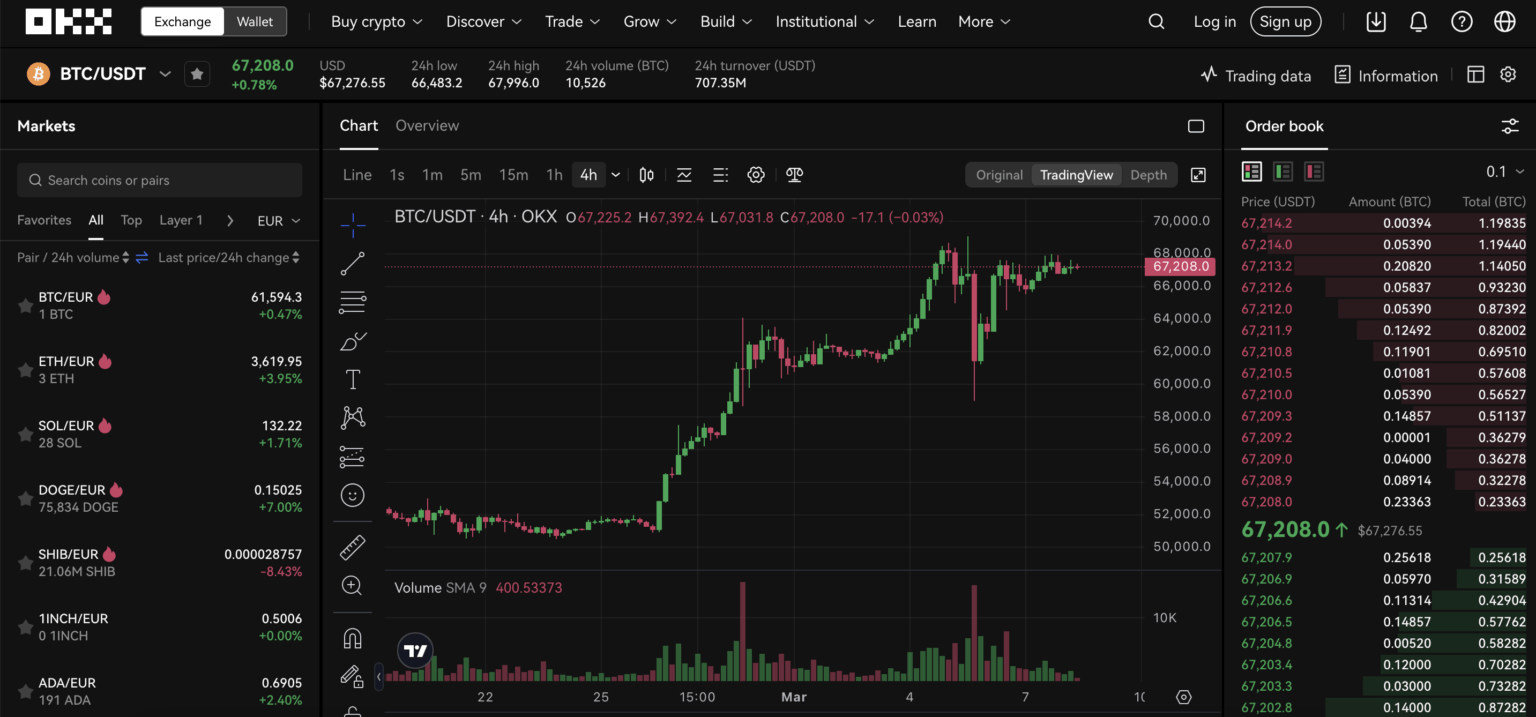
How OKX works under the hood — the mechanisms that matter
Start with custody. OKX stores over 95% of user assets in offline, air-gapped cold wallets protected by multi-signature (multi-sig) arrangements. Mechanistically, that reduces attack surface: a remote hacker can’t simply extract funds because multiple keys are distributed and at least some keys are in physically isolated environments. Proof of Reserves (PoR) complements that by providing an on-chain snapshot users can audit to see that the exchange’s wallet balances match reported liabilities — a transparency mechanism, not a substitute for ongoing independent audits or regulatory oversight.
On trading infrastructure, OKX combines a centralized exchange (CEX) matching engine with advanced charting (TradingView) and derivatives such as perpetual swaps, quarterly futures, and options. Perpetuals and high-leverage contracts (some assets allow up to 125x leverage) create sharp nonlinear risk: margin thresholds, funding-rate mechanics, and auto-deleveraging or liquidation ladders can quickly turn small price moves into large realized losses. For anything beyond routine spot trading, understand the contract specifications (tick size, margin mode—cross vs isolated, funding payment cadence) before sizing a position.
The platform also integrates a DEX aggregator, which sources liquidity from major automated market makers like Uniswap to find optimal swap routes and enable cross-chain transfers. That reduces slippage for simple token swaps compared with routing one’s own trades across fragmented DEX pools, but it introduces smart-contract and bridge risk whenever you move assets off the centralized ledger. OKX offers a non-custodial Web3 wallet option and hardware wallet support (Ledger/Trezor), so traders can choose custody models that match their risk tolerance and the use-case (trading vs long-term holding vs DeFi interactions).
Common myths vs. reality
Myth: “An exchange with cold storage means my funds are immune to loss.” Reality: cold storage dramatically reduces hot-wallet theft risk, but it doesn’t remove phishing, account takeovers, or smart-contract vulnerabilities when you use the exchange’s DeFi features. Operational security for login and account management is still the user’s first line of defense.
Myth: “Proof of Reserves proves solvency forever.” Reality: PoR is a helpful transparency signal showing a snapshot where on-chain reserves equal liabilities, but it’s not a continuous guarantee. It doesn’t capture off-chain obligations or timing mismatches, and a PoR method’s credibility depends on the exchange’s methodology and the frequency of updates. Treat PoR as one input, not definitive proof.
Myth: “High leverage is a free multiplier.” Reality: leverage magnifies both gains and losses and interacts with liquidity and margin rules. In fast markets, slippage and widening spreads can trigger liquidations even when a trader thinks the position size is safe. OKX’s margin modes (isolated vs cross) change the failure modes: isolated limits loss to that position’s collateral; cross shares margin across positions but risks wiping more capital if one contract moves quickly.
Logging in safely: practical steps and trade-offs
Secure login is a political as well as technical problem: it sits at the boundary between convenience and security. OKX provides biometric logins on mobile, mandatory 2FA (SMS, Google Authenticator, or biometrics), and AI-driven real-time threat detection. Those are strong controls, but they interact with user behavior in ways that matter.
Concrete checklist for US traders:
- Use a unique, strong password and enable 2FA with an authenticator app rather than SMS when possible (SMS is convenient but vulnerable to SIM swap attacks).
- Register and complete KYC in a controlled environment — KYC is required and includes ID and a liveness check; prepare for the privacy trade-offs and ensure documents are current.
- Consider separating assets by custody: keep trading collateral on the exchange for active positions, but move larger, longer-term holdings to a hardware wallet or the OKX non-custodial wallet with a seed phrase stored offline.
- Use withdrawal whitelists where possible and set withdrawal confirmation delays if you want a time window to react to unauthorized withdrawals.
- If you use the browser extension or mobile app, verify the exact domain and sign every message consciously — phishing sites mimic interfaces closely, so double-check the URL and certificate.
- For immediate access patterns, bookmark the official login route and avoid search-engine links; for convenience, note that OKX supports biometric mobile login, which is both fast and secure when combined with a device-level passcode.
For one-click convenience that still respects safety, the exchange’s ecosystem includes browser extension and mobile app pathways; if you need the web interface from a laptop, use a link you trust and confirm the site’s TLS certificate. For direct access guidance, here is a practical login resource: okx login.
Trading choices: spot, margin, futures — a functional comparison
Think of trading modes as tools with different failure modes, not merely risk multipliers. Spot trading is straightforward: buy low, sell high. Margin trading introduces counterparty-like debt: you borrow to amplify exposure up to 10x on OKX. The additional risk is liquidation through margin calls; cross-margin amplifies systemic exposure across positions, which can be useful for hedging but dangerous in correlated crashes.
Futures and derivatives are structurally different. Perpetual swaps have funding rates that periodically move money between long and short side; funding can turn a profitable strategy into a losing one if you ignore it. Quarterly futures lock you into a settlement schedule that can be used for calendar spreads and basis trades. Options add asymmetry — you can buy defined-risk exposure (long options) or sell for income but with potentially unlimited risk if you write naked positions. OKX’s up-to-125x leverage for selective assets is attractive for traders seeking large directional bets, but the practical trade-off is the exchange’s liquidity and the depth of the order book: high leverage is only safe where there is deep liquidity and tight spreads.
Where OKX shines and where it breaks
Strengths to lean on: broad asset coverage (300+ tokens), a multi-product ecosystem (CEX + DEX aggregator + Web3 wallet + NFT marketplace), robust cold-storage practices, and PoR transparency. For US traders, the interface and advanced charting (TradingView) help combine execution with technical analysis.
Limitations and failure modes: regulatory change is an external risk; local access and product availability can shift with jurisdictional rules. Liquidity risk in low-volume tokens is real — wide bid-ask spreads can make aggressive leverage fatal. Cross-chain bridge and smart-contract interactions inherit DeFi risks; moving assets out of the centralized ledger requires expertise and acceptance of different risk profiles, including irreversible mistakes (lost seed phrases, wrong-chain transfers).
Signals to watch next (conditional implications, not predictions)
Recently (this week), a major institutional move — an equity exchange investor participating in OKX at scale — would be a signal that centralized exchanges are attracting a different class of capital. If such institutional capital inflows continue, expect increased product standardization, tighter spreads on major pairs, and perhaps faster regulatory scrutiny in the US. Conversely, if regulatory bodies impose stricter rules on derivatives or cross-border custody, product availability (notably high-leverage futures) could narrow for US users.
Operationally, monitor funding-rate dynamics on perpetuals, order-book depth before placing large leveraged trades, and the cadence of Proof of Reserves disclosures. Those are directly observable signals that should inform position sizing and whether to keep capital on-exchange.
FAQ
Q: Is it safe to leave large sums on OKX if they advertise cold storage and PoR?
A: “Safe” is relative. Cold storage and PoR reduce certain institutional risks (hot-wallet theft, opaque balance sheets) but don’t remove user-level risks: account takeovers, phishing, and regulatory changes. For large holdings, a hybrid approach (small exchange balance for trading; bulk in hardware wallet or self-custody with robust offline seed storage) balances convenience and safety.
Q: Should I use cross-margin or isolated margin for futures on OKX?
A: Use isolated margin for discrete directional trades where you want loss limited to a single position; use cross-margin when you intentionally want collateral fungibility across hedged positions. Cross-margin can reduce the chance of a single liquidation but increases systemic risk across your account. Choose based on whether your positions are correlated and how much capital you can afford to lose.
Q: How real is the phishing risk and what practical steps stop it?
A: Phishing is very real and often invisible until damage occurs. Practical defenses: never click login links from email, bookmark the official site, use hardware-backed 2FA, restrict withdrawals using whitelists, and periodically verify account activity and device logins in the account security page.
Q: Are OKX’s DeFi and DEX features safe to use?
A: Using the DEX aggregator reduces swap slippage but adds smart-contract and bridge risk. If you interact through the non-custodial wallet with a hardware signer, you can limit exposure; still, treat bridge transfers as operationally risky and avoid moving large sums until you’re confident in the bridge’s security record and the involved contracts.
Final takeaway: OKX combines strong engineering (cold storage, PoR, multi-product ecosystem) with the known economic realities of crypto markets (liquidity, volatility, regulatory flux). For US traders, the right approach is layered: secure login and 2FA, thoughtful custody choices, conservative leverage sizing, and continuous monitoring of exchange-visible signals like funding rates and PoR updates. These steps turn a raw feature list into a working safety and trading framework you can apply today.
Where this analysis leaves room for judgment: regulatory changes or major institutional investments could materially alter product availability and market structure. Watch the observable mechanisms — not headlines — and adjust position sizes and custody choices accordingly.